|
Our Mission The mission of Jesuit Refugee Service/USA is to accompany, serve and advocate for the rights of refugees and other forcibly displaced persons. JRS/USA witnesses to God’s presence in vulnerable and often forgotten people driven from their homes by conflict, natural disaster, economic injustice, or violation of their human rights. As one of the ten geographic regions of the Jesuit Refugee Service, JRS/USA serves as the major refugee outreach arm of U.S. Jesuits and their institutional ministries, mobilizing their response to refugee situations in the U.S. and abroad. Through our advocacy and fund raising efforts, JRS/USA also provides support for the work of JRS throughout the world. JRS/USA gives help, hope, ear and voice to vulnerable people on the move by being present to and bearing witness to their plight; by relieving their human suffering and restoring hope; by addressing the root causes of their displacement and improving international responses to refugee situations. In addition, JRS/USA inspires the Ignatian family and others to respond together to the needs of refugees and displaced persons worldwide and forges strong partnerships with like-minded institutions and agencies devoted to the cause of refugees and displaced persons. JRS works in more than 50 countries worldwide to meet the educational, health, social and other needs of refugees and other forcibly displaced persons. JRS services are made available to refugees and displaced persons regardless of their race, ethnic origin, or religious beliefs. JRS provides primary and secondary education to approximately 170,000 children, and undertakes advocacy to ensure that all displaced children are provided with a quality education.
Jesuit Refugee Service/USA is a registered 501(c)(3) non-profit organization. Donations are tax-deductible to the fullest extent allowed by law. |
- History
- Beginnings
- Africa
- Americas
- Europe
- Summary
History of Jesuit Refugee Service
In the late 1970s, Fr. Pedro Arrupe, then Superior General of the Society of Jesus, was moved by the perilous journeys to exile of the Vietnamese boat people. Although the Vietnam War had ended in 1975, it was not until 1979 that great numbers of people began to leave the country and seek refugee elsewhere through clandestine, risky journeys by sea. At that time Fr. Arrupe appealed to Jesuit major superiors for practical assistance. The spontaneous and generous 'first wave of action' provoked him to reflect on how much more the Society of Jesus could do if its responses to this, and to other contemporary crises of forced human displacement, were planned and coordinated. From that initial sentiment has grown a world-wide service to forcibly displaced people. On November 14, 1980, Fr. Arrupe announced the birth of Jesuit Refugee Service. (See attached PDF.) The history of JRS is about the lives and hopes of people we know personally. This personal knowledge constantly transforms our understanding. JRS opens a door — beyond transitory and shocking images — into the inspiring lives of people struggling to defend their rights, protect their families and give their children a future. |
|
Beginnings in Asia The activities of Jesuit Refugee Service in the Asia region were at first responses to the reality of the Indochina wars. Most initiatives were set against the background of Cold War ideology and rhetoric. JRS quickly established programs in every camp that housed Lao, Cambodian and Vietnamese refugees throughout the Southeast Asian region. In Sri Lanka, many people were forced from their homes in 1983, when the ethnic Singalese reacted violently to armed campaigns by the 'Jaffna' Tamils. But through the 1980s JRS mainly worked with the ‘Tamil repatriates’ who came to India under an agreement between the two governments. In places where world politics was less dominant, local frontier politics loomed large, as with programs to assist the Burmese refugees in Thailand and in Bangladesh. India’s desire to maintain strong influence in Nepal and Bhutan, which are buffer states with China, has continued to dominate outcomes for Bhutanese refugees in Nepal. Although JRS directors were given authority to open programs wherever they identified a need and could find a way to begin, the best initiatives resulted from partnerships with local Jesuit Provinces. An invitation of this kind could open the possibility of matching outside expertise and resources with local knowledge, leading to more effective projects. Without a local community base, or without knowledge of local customs, people and languages, or without an invitation from a Jesuit Province ready to make a commitment, it was often difficult to form an effective team. |
|
Since half of the world’s refugees are located Africa, it is the continent where JRS is most present. Almost every African country has been touched by conflict at one point or another in the post-colonial period. The unresolved legacies of colonialism, bad governance, weak state structures and lack of leadership, the criminalization and militarization of economies and the contest for control of scarce resources, migratory pressures, are all factors that now make conflict and forced migration more likely. In 1982, Jesuits began the work of JRS in Ethiopia for those displaced by the Ethiopia-Somalia war and later by the Wallega famine of 1984-85. Seeing clearly the endemic nature of conflict in the region, and the prospect of enduring displacement of large populations, JRS accepted that its work there would not be accomplished quickly. Meanwhile in the early 1980’s in Rome, thousands of foreigners, especially Eritreans and Ethiopians displaced by war and famine at home, were left homeless in the city without shelter against the winter cold. So it was not surprising that the Jesuits of JRS began to assist these homeless migrants. Centro Astalli, a center for forced migrants in Rome, is one of the oldest JRS projects. In the mid-1990s, JRS arranged the purchase of property in Nairobi in the name of the Eastern Africa Jesuits, in order to provide a management base for its refugee work throughout East Africa. It also undertook to develop formation programs for its members serving there and saw the need for more in-depth studies of refugee problems. JRS continues to work in many different scenarios throughout Africa: from large refugee camps in Tanzania and Kenya to urban settings in Johannesburg or Nairobi; with repatriated refugees in South Sudan and the internally displaced people in Burundi and Darfur; and with former child soldiers in Chad, to name but a few. |
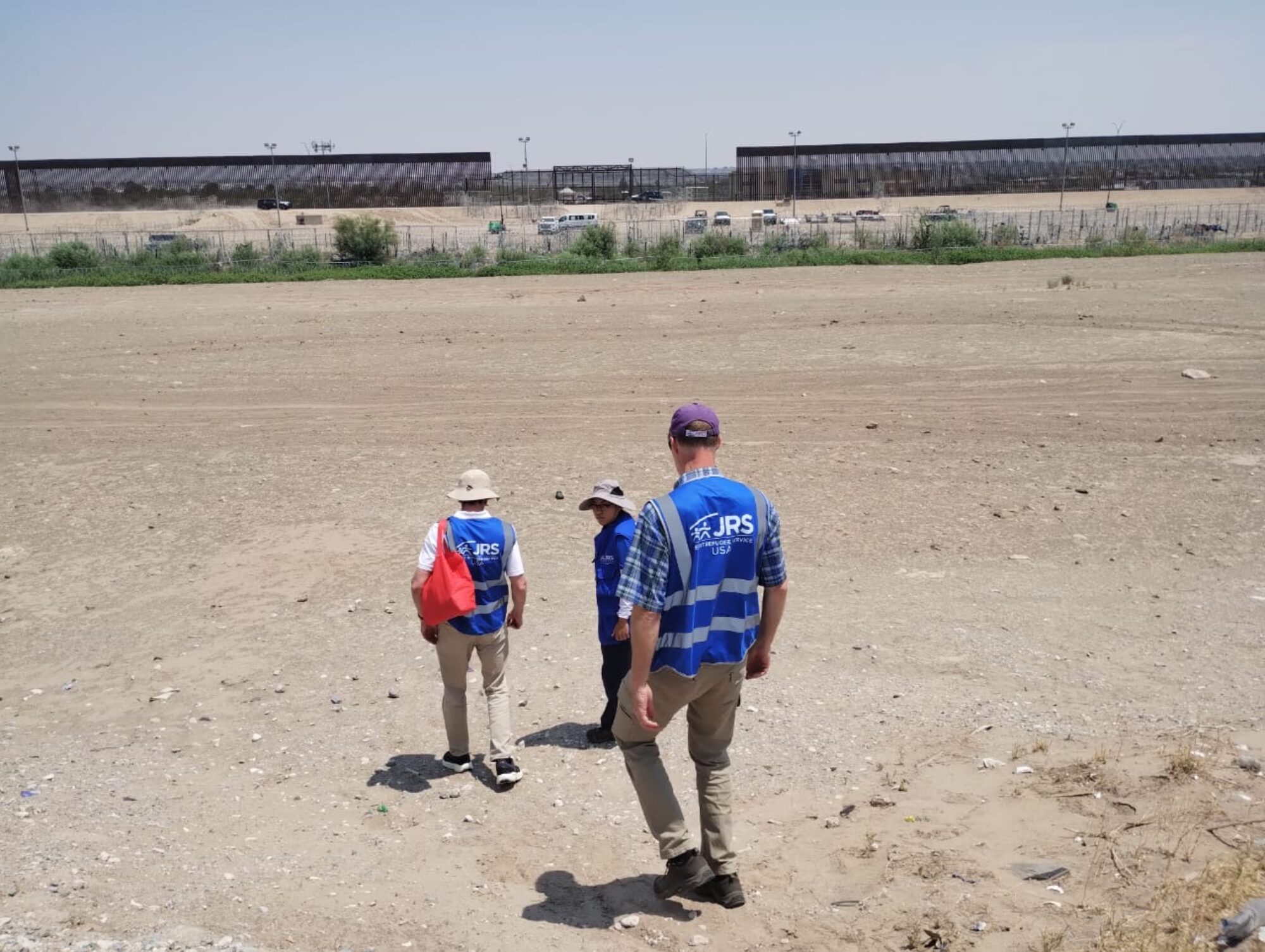
Download the attached PDF for a larger version of the chart to the right. In the Americas Jesuit Refugee Service has been caught between the demands of its mandate to serve the refugees and forcibly displaced, and the pastoral needs of migrants in general. As the Cold War ebbed, many of the liberation struggles in Latin America subsided, often without resolution of the fundamental problems that had given rise to them. JRS’ early experience in Latin America was among El Salvadorans dispersed throughout Central America. It also had an important program among Guatemalan refugees in Mexico, including a role in negotiations that enabled local settlement of some and the return of others. Today JRS works with forcibly displaced people from Colombia and Haiti. The JRS programs in Colombia show no sign of diminishing since the needs of people displaced within that country continue to grow. In neighboring countries such as Venezuela, there are Colombian refugees, who call on the direct services of JRS on the ground and JRS intervention in policy formulation. Small JRS programs have sprung up in other Latin American countries. In the Dominican Republic, a sizeable program has been developed since the late 1990s due to the critical need of the Haitians who cross their joint border daily, driven by the harsh economic and political situation in their homeland. The work of JRS in the United States and Canada focuses on projects mainly related to detention of migrants, advocacy and the promotion of research and publication. JRS/USA also supports JRS projects throughout the world through advocacy, fundraising efforts and the provision of personnel. |
|
JRS Europe In Europe, soon after the fall of the Berlin Wall in late 1989, conflict enveloped the region of the former Yugoslavia, which quickly fragmented in the early 1990s into six smaller states. Impulsive acts of violence created rifts that will still take generations to heal. For JRS, some challenges in the Balkans were totally new, some familiar. Based on deep friendships and trust, strong cooperative activities were developed with both Muslim and Serbian Orthodox communities. Eastern European countries have for many years provided a back door route into Western Europe for asylum seekers whose journeys began in such places as Sri Lanka, Sudan or Somalia. Many were stranded subsequently in societies facing difficult circumstances. Over the years since 1989, JRS has extended its roles in these countries, building on early beginnings in places of great need such as Romania. Western European authorities frequently fail to distinguish between a migrant and a refugee, despite continuing developments in international law designed to protect people in both categories. At the present time, punitive and seemingly xenophobic measures dominate the responses of western governments to the influx of asylum seekers. Alongside their many partners, JRS teams offer food and shelter to new arrivals, provide employment counselling, visit those in detention centres, provide information and public education, and help formulate just and appropriate policies. |
![]() Today Jesuit Refugee Service programs are found in more than 50 countries, providing assistance to refugees in camps and cities, individuals displaced within their own countries, asylum seekers in cities, and those held in detention centers. The main areas of work are in the field of education, emergency assistance, healthcare, livelihood activities and social services. At the end of 2009, more than 500,000 individuals were direct beneficiaries of JRS projects, and millions more are indirect beneficiaries. JRS provides primary and secondary education to approximately 170,000 children, and undertakes advocacy to ensure that all displaced children are provided with a quality education. More than 1,400 workers contribute to the work of Jesuit Refugee Service around the word, many of whom work on a voluntary basis, including about 78 Jesuits and 66 religious from other congregations. These figures do not include the large number of refugees recruited to take part in the programs as teachers, health workers and others. JRS is also very much concerned with advocacy and human rights work. This involves ensuring that refugees are afforded their full rights while in exile and during repatriation as guaranteed by the 1951 Geneva Convention relating to the Status of Refugees and working to strengthen the protection afforded to internally displaced persons (IDPs). It extends to advocating for and promoting international human rights legislation, either through participation in international campaigns and coalitions or through membership of international fora, such as the UN Economic and Social Committee (ECOSOC). JRS also contributes to refugee research at the University of Oxford. At Oxford, the Pedro Arrupe Tutor oversees research undertaken in the name of JRS as well as facilitating the training of JRS personnel. The main tasks of the tutorship include conducting research, teaching and offering consultancy regarding refugees and forced migration to church agencies, NGOs and governments. |