JRS is a Lifeline for Learning in South Sudan
29 May 2026|Rachael Davis, JRS/USA Manager
I work on Jesuit Refugee Service (JRS)/USA’s International Programs team from our office in Washington, D.C. Over the last 6 years, I have partnered with our office in South Sudan to implement an education program previously funded by the U.S. Department of State’s Bureau of Population, Refugees, and Migration and now funded by private donors to JRS. In April of this year, I visited our project in Maban County, Upper Nile State, South Sudan. This was the fourth time I visited our education programs in South Sudan, but I was most nervous about this visit to see how the situation on the ground had changed since the U.S. government cut funding.
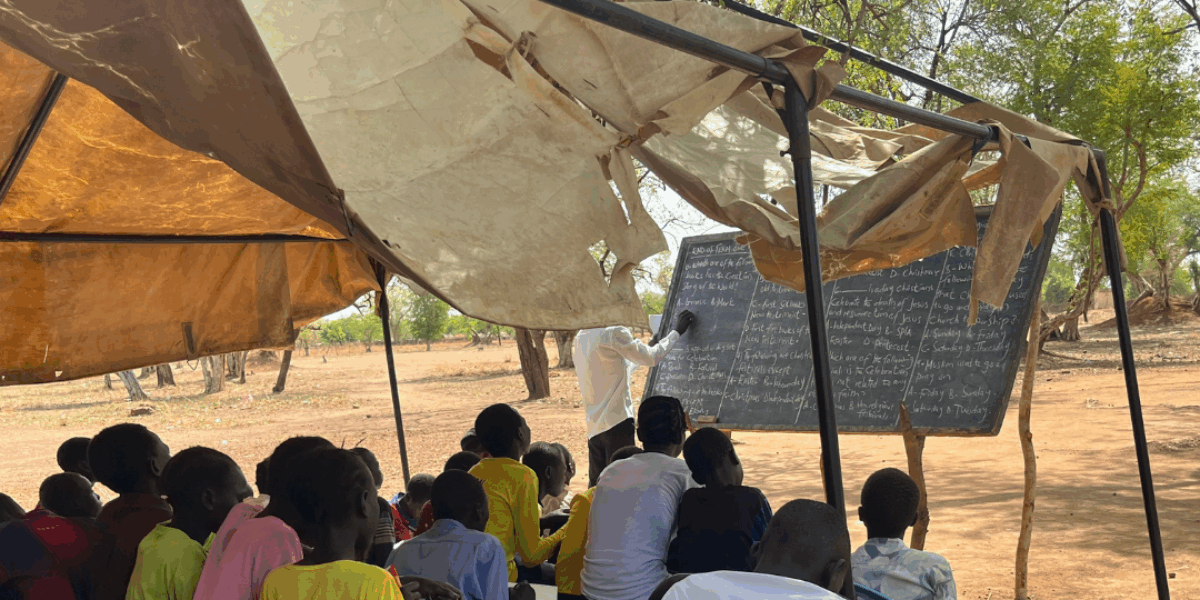
Huffra Primary School is located not far from the main road, in a dusty, unprotected open area. The classrooms come in different shapes and materials, four made with brick and iron-sheeting roofs, others with stick frames that hold up a grass roof. Some classes are simply conducted under shady trees. Unmistakable though, as you approach, is the cluster of students who have gathered, eager to learn.
The school was established in 2015 by a community of internally displaced people who fled their homes due to violence and traveled to this area seeking safety. As a community-based school, they started with no government support but were accompanied by Jesuit Refugee Service. A Parent-Teacher Association was established in 2016. The PTA is essential to the community in shaping and supporting what keeps the school running, such as repairing classrooms, mobilizing the community, and overseeing the headmaster’s and teachers’ performance – but the community needed additional support to keep the school running. Without support from the South Sudanese government, JRS funding has been a lifeline to the school.
The needs are greater than ever, as the number of students climbs each year: 386 students were enrolled in 2025; in 2026, 545 students are enrolled, with more expected. With State Department funding, JRS supported teachers’ salaries and training. When that funding ended, JRS mobilized private donors to step in to support nine teachers and a security guard, though that still does not come close to the support we were able to offer with State Department funding.
Two of the nine teachers JRS funding provides for are women, and the importance of that cannot be overstated. Most girls in South Sudan do not finish secondary school, making female teachers rare. The consequences of a low retention rate for female students include a literacy rate of 29% for women and girls in South Sudan, according to the last government figures. JRS prioritizes training and retaining female teachers to provide girls with role models and to show what education can mean for their future.
There are many gaps to fill; currently, in addition to the lack of classrooms and desks, there are no functioning latrines at the school, so teachers and students must use the wooded areas around the school property. The school’s headmaster is also worried about the security of the school because, without fencing around the school property, there is a major risk of armed gangs or opposition forces encroaching on the school property.
In spite of the challenges, the headmaster, teachers, and community members remain determined to keep the school running, providing essential education and a safe space for the students. JRS will continue to work with the school as long as necessary with a goal of eventually fully transitioning to a sustainable community-run model.
Explore more