JRS INSIDER | Where a Church Opened Its Doors, Community Took Root
06 February 2026|Chloe Gunther

For our first INSIDER of 2026, I spoke with two people who have been guiding JRS Lebanon through a year shaped by crisis, rebuilding, and constant uncertainty: Roy Gebrayel, JRS Lebanon’s country director, and Michael Petro, S.J., a Jesuit in formation and program manager for the new JRS Center in Beirut, who works closely with migrant and refugee communities there.
Their days are split between responding to the needs of the current population of refugees and migrants in Lebanon and preparing for the possibility that regional conflict could once again touch Lebanon’s own communities. They spoke of hope, not as an ideal but as something they see every day in the people they work with and for.
 On September 23, 2024, Israel began a series of airstrikes in Lebanon, killing hundreds of Lebanese in the first 24 hours. In Beirut, Roy awoke to a flurry of messages from his team in Baalbek, a city in northeast Lebanon’s Bekaa Valley, about 40 miles away. The war had arrived in their town.
JRS suspended all programs. The Baalbek team sent children in education programs home to their parents before fleeing to neighboring towns themselves.
“I’ll never forget that” Roy said. “The way our staff in Baalbek turned around to help people even as they experienced their own struggles of displacement and loss.”
That evening, a migrant woman and parishioner of St. Joseph Parish, called Michael Petro and asked if she and her five children could take shelter. She had previously attended the Arrupe Migrant Center (AMC), a ministry of St. Joseph Parish that has served as a central space for migrants for over 40 years. As Michael explained, what is the Church for if not to open its doors to those who need a safe place to rest?
Soon after the first family called, word spread that St. Joseph had opened its doors and many more in the community flocked. “For me, it is a vision of the early ways JRS operated, when people relied on relationships and trust to respond to evolving needs.”
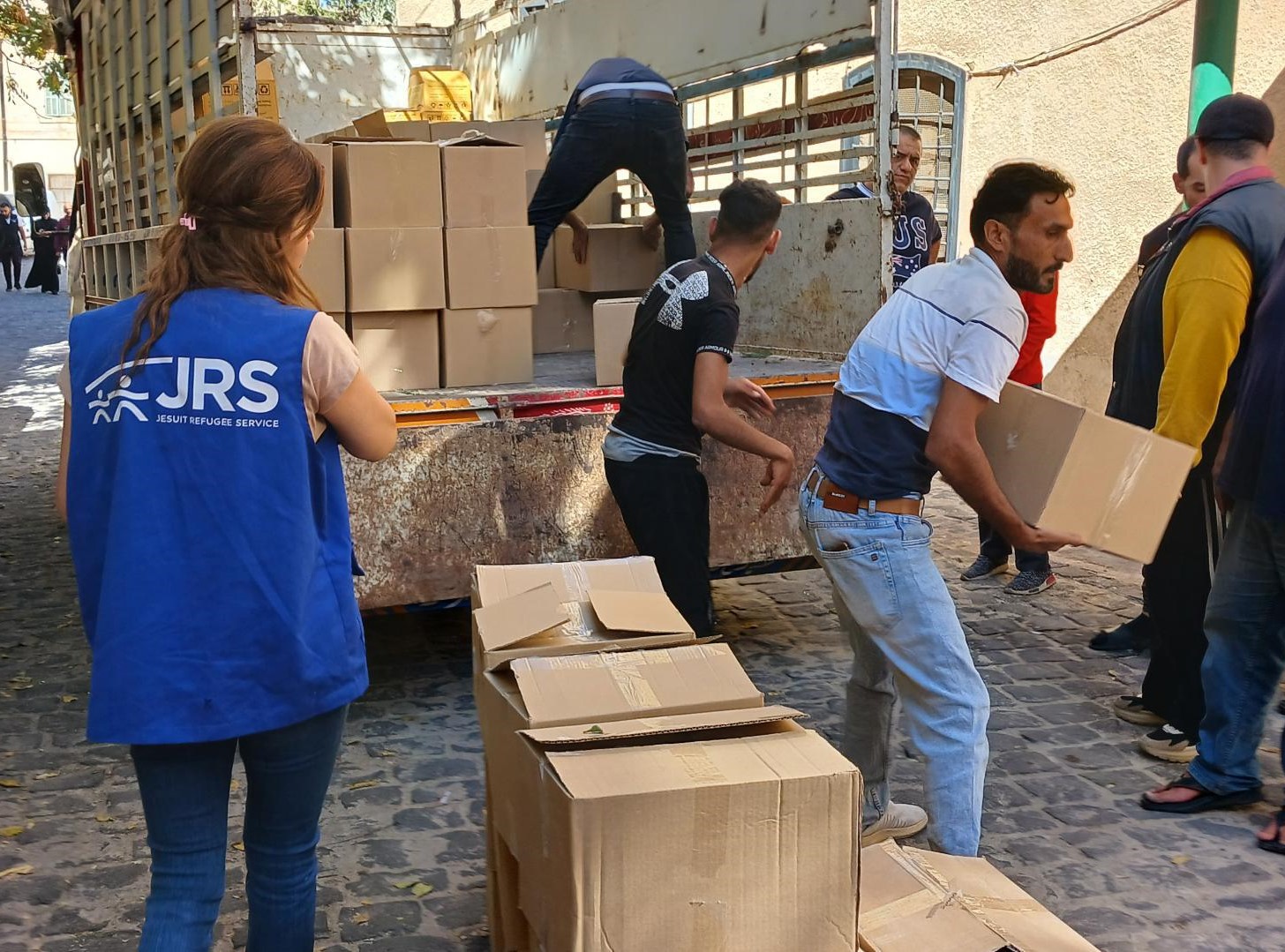
JRS Lebanon collaborates closely with the AMC and while much of JRS Lebanon’s work supports Syrian refugees, Michael and his team primarily serve migrant workers and refugees from South Asia, the Philippines, and East Africa. When it comes to humanitarian services, these communities are often excluded, and the gap between their needs and the support Lebanese people and Syrian refugees receive is wide. Emergency response is not usually this JRS office’s focus still the team pivoted and was able to respond. They kept some of the country’s most vulnerable communities safe in the middle of an unfolding crisis.
Before the war escalated, JRS Lebanon had been formalizing plans and identifying funding to open its new center, now managed by Michael, designed to serve migrant workers.
At the end of November, after thousands of lives were lost, Israel and Lebanon reached a ceasefire agreement. About 90 percent of the more than one million Lebanese displaced by the violence were able to leave the shelters. But again, migrant workers and minority refugees did not receive the same level of support. Many migrant workers had fled their employers’ homes to escape the bombing and lost their jobs as a result. So the church continued to host people in the church through mid-February.
Michael spoke about two shifts that happened for him and his team during the war. One was an expanding of their horizons for responding to their community’s needs. They got more creative and found ways to serve that were unimagined before. The second was a deeper sense of collaboration between migrant groups and JRS. Both shifts remain represented in their programs today as the country has rebuilt, and the JRS team has expanded.
Almost as soon as the team began this rebuilding, another crisis followed: massive cuts to U.S. foreign aid.
“Recovering from the war and then losing a lot of the resources we depended on was really a one-two punch,” Michael said.
And yet, throughout it all, Michael and Roy witnessed inspiring moments of leadership, selflessness, solidarity, and hope.
Michael shared the story of Martha*, a respected community leader and South Sudanese refugee. She runs the Sudanese Women’s Association, which now meets at the JRS Center to provide programming for women.
When violence broke out in southern Lebanon, she served as a linchpin for Sudanese and South Sudanese families looking for help. She brought them to the church and while the shelter was operating, she made sure meals were prepared, distributed, and that people were comfortable and cared for.
As Michael described her work and impact he admitted: “So much of her work was really just being present to the young mothers sheltering there.”
By March 3, the team was finally ready to open the new JRS center. “It probably took me at least six months to get to a point where I could start saying to myself, you are not in an emergency,” Michael said.
Because the team had already been preparing for the new project before the conflict, including conducting a needs assessment with the Lebanese American University in Beirut, they were able to move quickly. After updating the assessment to reflect how people’s needs had changed during the war, they transitioned directly from closing the shelters to opening the center.
The new JRS center, located closer to the neighborhood where many migrant communities live, supports migrant workers and minority refugee communities through mental health and psychosocial support, including group therapy sessions, community awareness-raising, and individual counseling. It offers legal assistance to help people address documentation issues and understand civil procedures. It also provides mediation with employers to help combat exploitation.
What Michael loves most, though, is the hospitality the center extends to migrant- and refugee-led initiatives like Martha’s.
“These initiatives are the clearest distillation of hope to me,” he said. “Sixteen groups that did not have anywhere to meet now have a space to gather and call home. I’m really proud of that.”
Today, the Sudanese Women’s Association offers English classes and computer literacy programs three to four times a week at the JRS center.
“She is a remarkable example of generosity and creativity on the part of migrant and refugee organizers,” Michael said.
Martha is now part of the JRS Lebanon team, continuing to serve as a bridge between JRS and the communities it accompanies.
 Though they still must rebuild and want to expand, the situation remains precarious.
“We will be much better prepared this time,” he added. “Even though I hope there is not this time.”
He finds hope in the JRS community, in the ways God is at work in them. People like Martha and others on his staff who work tirelessly to walk with those who need them the most.
That hope was visible during Pope Leo’s visit this past December. Amid the threat of renewed conflict, economic strain, and cultural tensions, people gathered by the sea to pray for peace.
“It was very moving,” Michael said. During the visit, Pope Leo listened to testimonies from several members of the Church in Lebanon, one of whom was Loren, a migrant worker from the Philippines. She came to Lebanon 17 years ago and has spent years serving in the AMC. During the war, she found refuge in JRS’ emergency shelter in the church, all the while serving as its logistics officer. You can listen to her poignant testimony here.
For Roy, hope is also taking shape in JRS Lebanon’s education programs. After the conflict, many children in Baalbek were afraid to return to school. They feared their homes would be bombed while they were gone or that they would lose their parents.
In response, the team focused on bringing parents more fully into the day-to-day programs. They created parent committees to open space for feedback, to share important updates from the Ministry of Education, UNHCR’s strategy, and the Lebanese government, and to strengthen overall
The team is also working to improve relationships between Lebanese families, Syrian refugees, and other migrants and refugees. Tensions between communities are always present and can disrupt daily life. The situation in Syria remains extremely fragile, and families who had previously returned are now coming back to Lebanon and asking to re-enroll their children in school.
Rebuilding for JRS Lebanon has meant holding all these complexities at once: the memory of the emergency, the loss of life and home, the daily threat that all could be lost again, the ongoing needs of an already vulnerable community, and the determination that “hope is a verb” most active when communities gather, heal, learn, and believe in a future of their own not marked by war.
Explore more